
If you’re in tooth pain right now — stop reading and call us.
(214) 306-8088 — Thrive Dental & Orthodontics Dallas
We’re on the corner of Frankford and Preston Road. We prioritize patients in pain and will do everything we can to see you today. Get directions.
Most dental offices refer root canals to an endodontist — a specialist whose fees are significantly higher than in-house treatment. A specialist root canal can cost two to three times more than the same procedure performed by an experienced in-house dental team. Add the delay of waiting days for a specialist appointment while you’re in pain, a second office to navigate, and separate records — the referral path is both more expensive and more inconvenient.
At our Dallas office, we perform most root canals in-house. Our dental team handles the vast majority of cases comfortably and effectively — same day when clinically appropriate. You call with a toothache, we assess it, and if a root canal is what you need we treat it at the same appointment in most cases.
We’re honest about what we refer. Extremely calcified canals, severely curved roots, or cases that genuinely need specialist-level intervention are coordinated appropriately. Those are a minority. Most of what Dallas patients present with, we handle right here — at significantly lower cost and with far less delay.
A tooth infection doesn’t stay contained to the tooth. Without treatment, bacteria spread from the pulp to surrounding bone, then to the soft tissues of the jaw and neck. In serious cases a spreading infection can compromise the airway.
Pain that comes and goes doesn’t mean the infection is resolving — it often means the nerve has died while bacteria continue spreading silently.
Signs requiring same-day care:
Call (214) 306-8088 immediately if you have any of these. Our Dallas emergency dental team prioritizes patients in pain and will see you the same day whenever possible.
Inside every tooth beneath the enamel and dentin is a soft core called the pulp — containing nerves, blood vessels, and connective tissue. When bacteria reach the pulp through a deep cavity, a crack, or trauma, infection develops. Once infected, the pulp cannot heal on its own. Bacteria spread, pain intensifies, and without treatment the infection moves into surrounding bone and tissue.
A root canal removes the infected pulp, cleans the canal space thoroughly, seals it permanently, and preserves the tooth — in most cases for decades. According to the American Association of Endodontists, more than 15 million root canals are performed in the US every year. It is one of the most routinely performed dental procedures — and the one with the most undeservedly bad reputation.
The pain patients associate with root canals is the pain of the infection before treatment. The procedure itself removes that pain. With modern local anesthetic, a root canal is clinically comparable in comfort to having a filling placed.

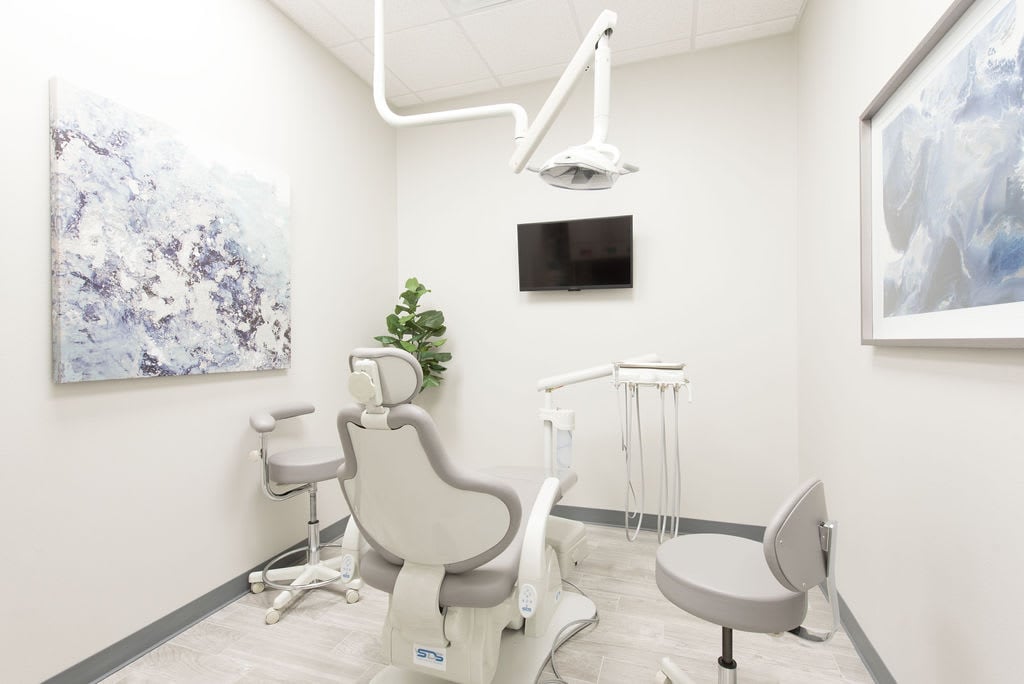
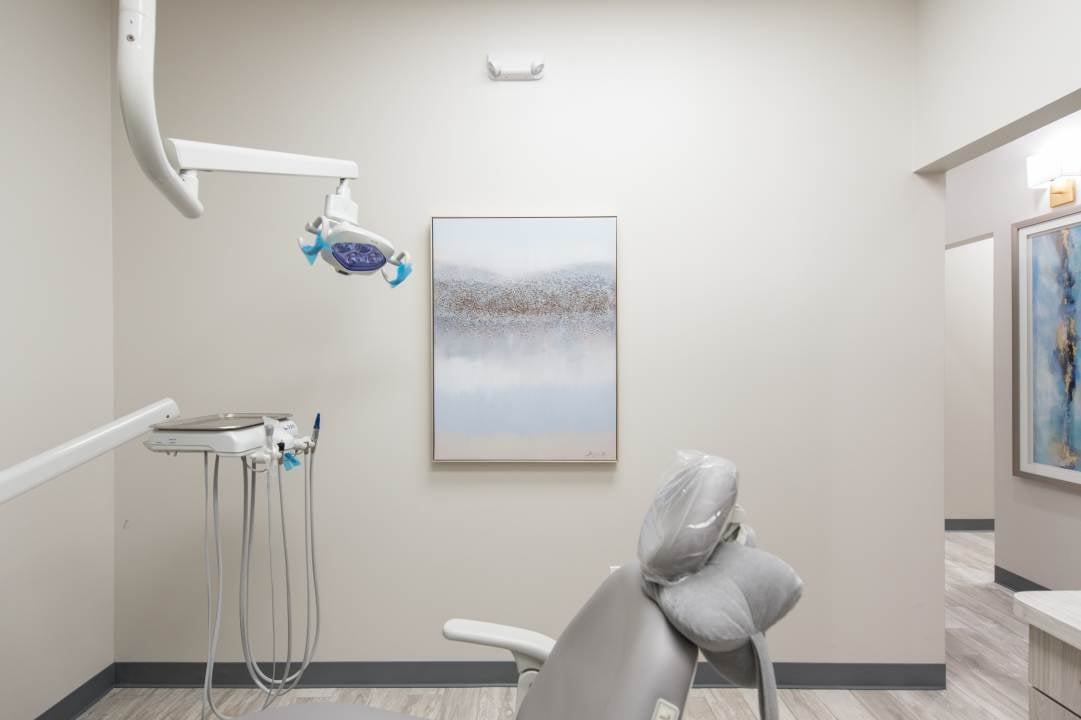
Every patient at our Dallas office is treated in their own treatment room with two TVs — one above the chair, one at eye level — and Netflix available throughout your appointment. Comfort headphones in every room. A pillow and blanket if you want them. A warm towel when you’re done.
Root canal appointments run 60–90 minutes for most cases. Patients consistently tell us that a familiar show on screen combined with thorough numbing made the experience far more manageable than they anticipated. The reputation doesn’t match the reality — and our Dallas treatment environment helps.
For patients with significant anxiety, nitrous oxide is available at our Dallas office. Inhaled through a comfortable mask, it creates calm and relaxation within minutes — the local anesthetic handles all pain prevention, the nitrous handles the anxiety. It clears completely when the mask is removed so most patients drive home normally.
At your root canal appointment, digital X-rays and intraoral photos are displayed on the TVs in your treatment room in real time. You see exactly what your dentist sees — the extent of infection in surrounding bone, the canal anatomy, the clinical reason treatment is recommended — before any work begins.
For patients who have felt kept in the dark at other offices, this changes the dynamic completely. You understand exactly what’s happening and why, rather than simply being told you need a root canal and trusting blindly. The Medit intraoral scanner — used for crown fabrication after root canal treatment — means no impressions at any stage of your care at our Dallas office.
Patients often ask whether to save the tooth or simply extract it. In almost every case, saving your natural tooth with a root canal is the better long-term outcome.
Your natural teeth maintain the jawbone density around them, support neighboring teeth structurally, and function more efficiently than any replacement. When a tooth is extracted, the bone beneath begins to resorb within weeks and neighboring teeth gradually shift toward the gap.
Replacing an extracted tooth requires a dental bridge or partial denture — both of which cost more than a root canal and crown combined. A root canal followed by a crown preserves your natural tooth and with proper care can last decades. When extraction is genuinely the right call — when a tooth is too fractured or bone loss is too severe — we say so clearly and discuss your options. But we always explore saving the tooth first.

Your dentist takes digital X-rays, reviews them with you on the treatment room TV, assesses canal anatomy and infection extent, and determines whether in-house treatment is appropriate. For most cases, we proceed to treatment at the same appointment.
Local anesthetic is administered to fully numb the tooth and surrounding tissue. You feel pressure during the procedure but should not feel pain. We do not begin any instrumentation until you’re completely comfortable — and if you feel any discomfort at any point, more anesthetic is administered immediately. Nitrous oxide is available for additional support.
Once you’re numb and settled, Netflix goes on. Two TVs, comfort headphones, a pillow and blanket if you want them. The appointment runs 60–90 minutes for most cases. Patients who come in tense consistently tell us the experience was far easier than they expected.
A small opening is made in the top of the tooth to access the pulp chamber. The infected pulp, nerve tissue, and bacteria are carefully removed from the chamber and each root canal using fine instruments. The canals are shaped and irrigated thoroughly with antimicrobial solution. This step determines long-term success and is done without rushing.
Canals are filled with gutta-percha — a biocompatible rubber-like material — and sealed permanently against future bacterial entry. A temporary or permanent filling closes the access opening.
Most root canal-treated teeth need a dental crown to restore strength and protect against fracture — particularly back teeth absorbing significant bite force. At our Dallas office we use the Medit scanner for crown fabrication — no impressions — and place same-day temporary crowns so your tooth is protected from day one. Full details on our Dallas dental crowns page.

First 24–48 hours: Some soreness when biting is normal. Ibuprofen addresses both pain and inflammation. Eat soft foods. Avoid chewing on the treated side until the permanent crown is placed.
Prescriptions: If pain medication or antibiotics are needed, our Dallas team prescribes at your appointment. The nearest pharmacy is just minutes from our Frankford and Preston Road office — your prescription is filled quickly without an extra trip across Dallas.
Getting the crown promptly: A root canal-treated tooth without crown protection is significantly more prone to fracture. Don’t delay the crown appointment — it protects the investment you’ve made in saving the tooth. We place same-day temporaries so the tooth is protected from your very first appointment.
Long-term care: Maintain your regular dental cleanings every six months. Your dentist monitors root canal-treated teeth and crown integrity at every routine exam.
Root canal cost varies based on which tooth is being treated and case complexity. By performing root canals in-house rather than referring to a specialist, our Dallas office keeps costs significantly lower — often two to three times less than endodontist rates.
Most PPO dental insurance plans contribute toward root canal treatment. We accept 18+ PPO plans at our Dallas location and maximize your benefits at every appointment. Our team verifies your specific benefits before treatment so you know your out-of-pocket estimate before we begin.
For patients without insurance, Cherry financing provides flexible monthly payment plans with quick approval. FSA and HSA payment is accepted. Our Healthy Smiles Discount Plan at $89/year provides discounted rates on root canals and crowns. Visit our insurance page for the full carrier list.
Our Dallas office is at 17977 Preston Rd Unit A — on the corner of Frankford and Preston Road, convenient for patients throughout north Dallas. We serve patients from Preston Highlands, Preston Road, Lake Highlands, Uptown, and Oak Lawn.
Nearest pharmacy: directions here.
Get directions · Book online · (214) 306-8088
Hours: Monday–Thursday 10am–6pm · Friday 10am–5pm
No — not the procedure itself. With modern local anesthetic, a root canal is genuinely comfortable during treatment. You feel pressure and movement but not pain. Nitrous oxide is available for additional support at our Dallas office. After the anesthetic wears off, mild soreness for two to three days is normal and manageable with over-the-counter pain medication.
In most cases, yes. We prioritize patients with dental pain and can often diagnose and treat at the same appointment. Call (214) 306-8088 and let us know you’re in pain — we’ll get you in as quickly as possible.
For the majority of cases, no. We perform root canals in-house at significantly lower cost than specialist endodontist rates. Complex cases that genuinely need specialist intervention are referred — but that’s a small minority of what we see.
For most teeth — especially molars and premolars — yes. Root canal-treated teeth become more brittle over time and are significantly more prone to fracture without crown protection. We place same-day temporary crowns at our Dallas office so the tooth is protected from the day of your root canal appointment.
Yes — our Dallas office uses the Medit intraoral scanner for all crown fabrication. No impressions, no putty. Full details on our Dallas dental crowns page.
Yes — the nearest pharmacy is just minutes from our Frankford and Preston Road office.
Yes — FSA and HSA payment is accepted at our Dallas location. Cherry financing is also available for flexible monthly payment options.
Tooth pain is your body asking for help. The sooner we see you, the more options we have — and the faster we get you out of pain.
(214) 306-8088 — Thrive Dental & Orthodontics Dallas
17977 Preston Rd Unit A — corner of Frankford and Preston Road.
Conveniently located throughout the Dallas area to serve you better
Book your appointment today and experience the difference of premium dental care at an affordable price.