
Nobody wants to hear they need a tooth pulled. At Thrive Dental & Orthodontics in Frisco, we only recommend an extraction when it’s genuinely the right decision — and when it is, we make the procedure as comfortable as possible, give you a clear plan for what comes next, and make sure your prescription is filled before you’re even home.
We perform routine dental extractions in-house at our Frisco location, with nitrous oxide available for patients who want to take the edge off. We offer bone grafting at the time of extraction to protect your jaw for future restoration. And the Walgreens nearest our office is just minutes away for same-day prescription pickup.
We’re on the corner of Hillcrest and Rolater Road in east Frisco. Get directions. Book online or call (972) 371-0616.
Extraction is never our first recommendation. Before suggesting removal, our Frisco dental team evaluates every realistic option for saving the tooth — a root canal, a dental crown, gum disease treatment, or a combination. Your natural teeth are irreplaceable in ways that no restoration fully replicates — they maintain jawbone density, support neighboring teeth, and function more efficiently than any artificial alternative.
When a tooth genuinely cannot be saved — when decay is too advanced, the root is fractured, infection has spread too far, or the tooth is too impacted to erupt safely — extraction is the right decision. Leaving an unsaveable tooth in place risks spreading infection, causing pain, and making eventual treatment significantly more complex and expensive.
When we recommend extraction at our Frisco office, it’s because we’ve assessed that it’s the best decision for your long-term oral health. We explain exactly why before proceeding and always give you the information you need to make the decision for yourself.

Common reasons our Frisco patients need an extraction:
Severe decay. When a cavity has progressed so far that the tooth structure is too compromised for a crown or filling to restore it effectively, and a root canal isn’t viable, extraction removes the source of infection and pain.
Cracked or fractured tooth. A crack that extends below the gumline or splits the root cannot be repaired. Extraction, followed by bone grafting and eventual restoration, is often the cleanest path forward.
Advanced gum disease. When periodontal disease has caused significant bone loss around a tooth, it may become loose and unable to be retained. Extraction prevents the infection from spreading further.
Wisdom teeth. Impacted wisdom teeth, partially erupted wisdom teeth trapping bacteria, or wisdom teeth positioned to threaten adjacent teeth often need removal. We handle routine wisdom tooth extractions in-house at Frisco — more complex impacted cases are coordinated within our Thrive network.
Orthodontic extractions. Occasionally braces or Invisalign treatment requires removing one or more teeth to create space for proper alignment. These are planned, predictable extractions coordinated as part of your overall orthodontic treatment plan.
Dental emergencies. A severely infected tooth, a broken tooth from trauma, or a tooth that has abscessed beyond treatment may require emergency extraction. We see emergency dental patients same day whenever possible — call us immediately if you’re in this situation.
Dental anxiety is extremely common, and extractions are among the procedures patients feel most nervous about. At our Frisco office, nitrous oxide — laughing gas — is available for any patient who wants additional comfort during their extraction.
Nitrous oxide is inhaled through a small mask placed over the nose. Within a few minutes, most patients feel relaxed, calm, and noticeably less focused on what’s happening in the chair. The local anesthetic still handles all pain prevention — the nitrous handles the anxiety. The two together make for a remarkably manageable experience even for patients who have avoided the dentist for years because of fear.
The key advantage of nitrous over deeper sedation is recovery time. Nitrous wears off within minutes of removing the mask — most patients can drive themselves home and return to normal activity the same day. For most patients with moderate anxiety, it provides exactly the right level of additional comfort without the hours-long recovery of IV sedation.
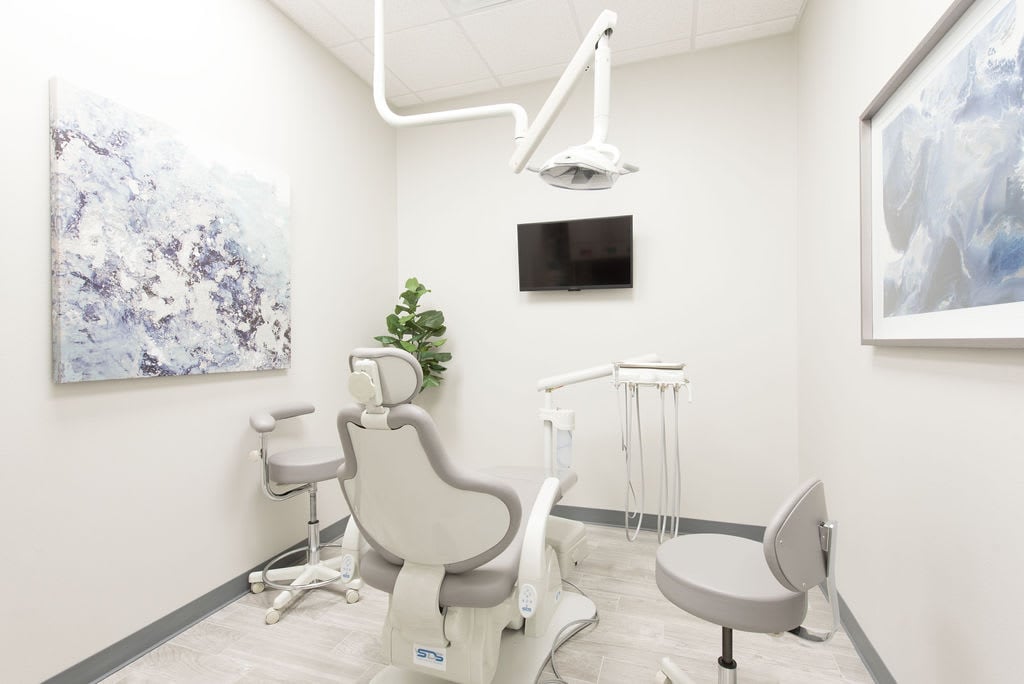
Netflix on the two TVs in every treatment room also helps considerably. For patients who arrive tense and anxious, having a familiar show on screen while they’re fully numb changes the experience more than most people expect. Pick something you’ve been watching — the appointment goes faster than you think.
Simple extractions involve teeth that are fully erupted above the gumline and structurally intact. The tooth is loosened with a dental elevator and removed with forceps. Quick, straightforward, and handled routinely at our Frisco location with local anesthetic and optional nitrous oxide.
Surgical extractions involve teeth that are broken at or below the gumline, impacted below the surface, or positioned in a way that requires removing some surrounding tissue or bone to access properly. More involved, but still performed in-office for most cases.
For cases more complex than what we should handle in-house at Frisco, we coordinate within our Thrive network first — our sister offices across the Dallas area have broader oral surgery capabilities, and because you’re already a Thrive patient, your records and treatment history are immediately available. For truly complex cases beyond what any Thrive location handles, we refer to trusted outside oral surgeons and coordinate directly.
After an extraction, if pain medication or antibiotics are prescribed, you want them quickly — not after a drive across Frisco and an uncertain wait. The Walgreens nearest our Frisco office is just minutes away. For most patients, the prescription is filled before they get home.
Our Frisco dental team prescribes pain medication and antibiotics at your appointment when clinically appropriate — for significant post-procedure discomfort, active infections, or conditions requiring antibiotic coverage before or alongside treatment. You leave with what you need.
This is one of the most clinically important things we do at our Frisco location — and one of the decisions patients most often thank us for later.
When a tooth is extracted, the jawbone that surrounded the root begins to resorb within weeks. Without the stimulation of a tooth root, the bone loses height and density — a process that continues for months and significantly affects your future restoration options. The gap left by an extracted tooth becomes less suitable for a bridge as bone height decreases, and the cosmetic result of any restoration deteriorates as surrounding tissue sinks.
A dental bone graft placed at the same appointment as the extraction fills the socket with grafting material that preserves its height and volume while healing occurs. It adds only a few minutes to the extraction procedure and significantly expands your options for tooth replacement later — whether that’s a bridge, partial denture, or other solution.
We recommend bone grafting to most patients at the time of extraction. It’s optional, not required — but in almost every case it’s a worthwhile investment in both jaw health and future treatment flexibility. Our Frisco dental team will discuss this clearly at your appointment so you understand the decision you’re making before we proceed.

The first 24 hours — the most important period:
Bite firmly on gauze for 30–45 minutes after the procedure to help the blood clot form in the socket. The clot is critical — it protects the underlying bone while healing begins.
Avoid anything that creates suction or pressure: no straws, no smoking, no vaping, no forceful rinsing, no carbonated beverages. These can dislodge the clot and lead to dry socket — a painful complication we want to help you avoid.
Apply a cold compress to the outside of your cheek for 15–20 minutes at a time to manage swelling. Take ibuprofen as directed — it addresses both pain and inflammation. Stick to soft foods: yogurt, scrambled eggs, mashed potatoes, soup, smoothies eaten with a spoon.
Days 2–4:
Continue soft foods. Avoid straws and smoking. Begin gentle warm salt water rinses after meals — let the liquid pool gently over the site and drain out rather than swishing or spitting. Avoid the extraction area when brushing.
When to call us:
Pain that intensifies after day three rather than gradually improving, significant swelling, fever, or an unpleasant taste in the mouth can indicate dry socket or infection. Call us promptly — both are treated quickly and effectively when addressed early.
Extraction is the beginning of the next chapter, not the end of the story. Once the socket heals — typically four to six weeks after a simple extraction with bone grafting — we discuss your options for restoring the gap.
Dental bridge: A fixed, non-removable restoration anchored to the adjacent teeth on either side of the gap. A strong, long-lasting option when neighboring teeth are healthy and suitable for crown placement, particularly when bone grafting was performed at the time of extraction to preserve adequate bone volume.
Partial denture: A removable appliance replacing one or more missing teeth. More affordable upfront than a bridge, and a practical option when adjacent teeth aren’t strong enough to anchor a bridge or when multiple teeth in different areas are missing.
Full dentures: For patients missing most or all of their teeth, full dentures restore the appearance of a complete smile and basic chewing function.
Immediate dentures: Placed the same day as extractions so patients never go without teeth during the healing period. As the gums and bone heal and change shape over the following months, the denture is adjusted to maintain fit. We offer immediate dentures at our Frisco location — ask our team if this option is relevant for your situation.
We discuss replacement options at your extraction appointment so you leave with a clear picture of what comes next — timeline, cost, and what each option involves.

Tooth extraction costs vary based on whether the extraction is simple or surgical, and whether bone grafting is performed. Most dental insurance plans cover a portion of extraction costs — typically at the basic restorative tier for simple extractions after the deductible. Our team verifies your specific benefits before treatment so you know your estimated out-of-pocket before we begin.
We accept 18+ PPO dental insurance plans at our Frisco location. For patients without insurance, our Healthy Smiles Discount Plan provides discounted rates on extractions and all other services — $89/year for the primary member, $49/year for each additional family member. Visit our insurance page for the full carrier list. In-house payment plans are available for larger treatment costs.
Dry socket is the most common complication after tooth extraction. It happens when the blood clot that forms in the extraction socket dissolves or dislodges before healing is complete — exposing the underlying bone to air, food, and bacteria. It is intensely painful and requires a dental visit to treat.
Dry socket typically develops two to four days after extraction — when pain that was improving suddenly worsens significantly. The socket appears whitish or grayish rather than showing a dark clot.
Prevention is almost entirely in your hands for the first 72 hours: no straws, no smoking or vaping, no forceful rinsing or spitting, no carbonated beverages. Following these instructions carefully is the most important thing you can do. We send you home with clear written instructions and our phone number — if anything feels wrong, call us.
If dry socket develops, we treat it promptly with a medicated dressing that relieves pain quickly and protects the socket while healing resumes. Most patients feel significantly better within 24 hours of treatment.
The extraction itself is performed under local anesthetic — you feel pressure and movement but should not feel pain. Nitrous oxide is available for additional comfort. After the anesthetic wears off, mild to moderate soreness for two to three days is normal and manageable with over-the-counter pain medication. Most patients are surprised by how manageable the experience is.
A simple extraction typically takes 15–30 minutes from anesthetic to completion. Surgical extractions take longer depending on complexity. Bone grafting adds a few minutes. Plan for a total visit of about an hour including check-in, anesthetic administration, and post-procedure instructions.
For simple extractions with local anesthetic only, many patients return to desk work the same day or next day. Avoid strenuous physical activity for at least 48 hours — it elevates blood pressure and increases bleeding risk. Nitrous oxide patients can drive home and return to normal activity the same day once the gas has fully cleared.
A bone graft placed at the time of extraction fills the socket with bone grafting material that preserves jaw height and volume while healing occurs. Without it, the bone naturally resorbs and shrinks in the weeks and months following extraction. We recommend it for most patients — particularly if you’re considering a bridge or any future restoration. It’s a short addition to the extraction procedure with meaningful long-term benefits
The socket typically needs four to six weeks to heal after a simple extraction before a bridge can be fitted. Partial dentures can often be made shortly after extraction. Immediate dentures are placed the same day as extraction. We discuss the timeline for your specific replacement option at your extraction appointment.
We assess complexity before proceeding. If a case exceeds what we handle in-house at Frisco, we coordinate within our Thrive network first — your records travel with you seamlessly. Truly complex cases go to trusted outside oral surgeons we work with directly. You’ll always know before your appointment whether we’re handling it in-house or coordinating a referral.
The critical rules for the first 72 hours: no straws, no smoking or vaping, no forceful rinsing or spitting, no carbonated drinks. All of these can dislodge the blood clot from the socket. Soft foods, gentle salt water rinses after the first 24 hours, and rest protect the healing site. If pain worsens after day three rather than improving, call us immediately — dry socket is treatable but needs prompt attention.
When a tooth needs to come out, we make the process as comfortable and straightforward as possible — and we make sure you leave with a clear plan for what comes next.
Book your appointment at Thrive Dental & Orthodontics Frisco — corner of Hillcrest and Rolater Road. Or call (972) 371-0616 if you need to be seen today.
Conveniently located throughout the Dallas area to serve you better
Book your appointment today and experience the difference of premium dental care at an affordable price.