
Dry socket is one of the most painful complications that can follow a tooth extraction — and unfortunately, one of the most Googled. If you’re reading this in the days after a tooth was pulled and something doesn’t feel right, this guide covers everything you need to know.
The good news: dry socket is treatable, manageable, and in most cases preventable when you follow the right aftercare.
What is dry socket?
After any tooth extraction, your body forms a blood clot in the empty socket left behind in the jawbone. That clot serves two critical purposes: it stops the bleeding and acts as a protective covering over the exposed bone while new tissue grows in to heal the site.
Dry socket — medically called alveolar osteitis — happens when that blood clot dissolves, dislodges, or never forms properly. Without it, the underlying bone and nerve endings are directly exposed to air, food, fluids, and bacteria. That exposure is what causes the intense, radiating pain dry socket is known for.
It’s not an infection, though infection can occasionally develop alongside it. It’s a healing complication — and it’s one of the few post-extraction problems that genuinely requires a dentist visit rather than time and rest alone.
Dry socket affects roughly 2–5% of all tooth extractions. It’s significantly more common after wisdom tooth removal — particularly lower wisdom teeth — where rates can climb as high as 30% in high-risk patients.
What does dry socket look like?
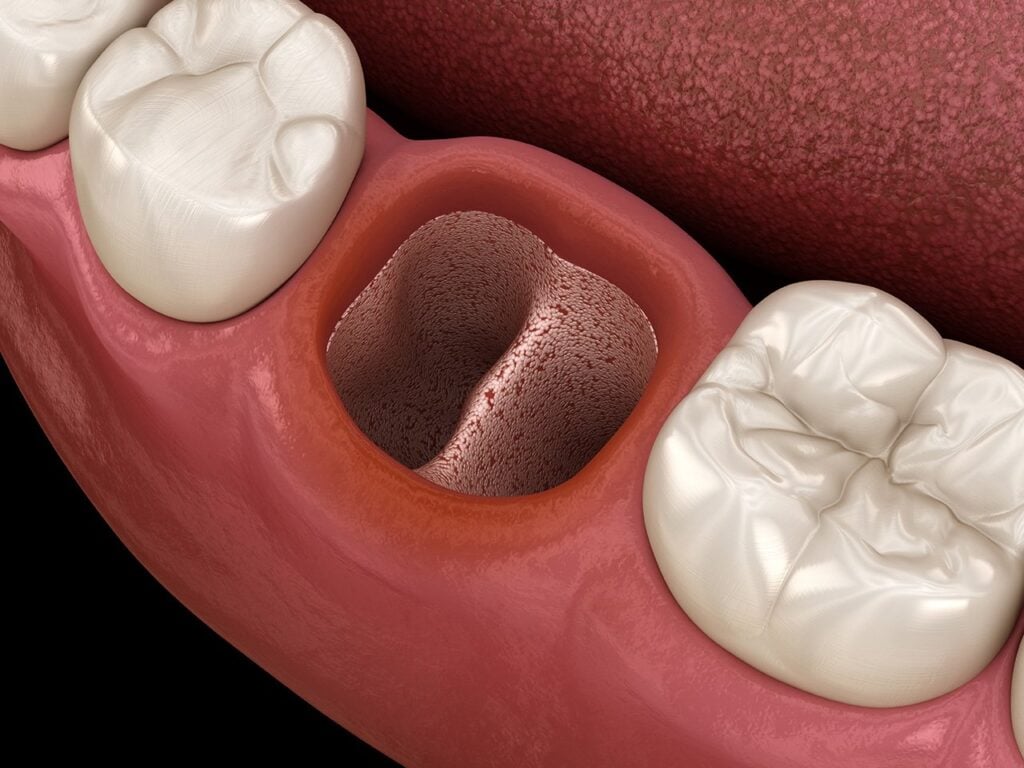
A normal healing extraction site looks like a dark red or maroon clot sitting in the socket, like a small crater filling in. That dark color is the blood clot doing its job.
A dry socket looks distinctly different. The socket appears empty, and instead of a dark clot, you’ll see the bottom of the hole is a whitish, yellowish, or grayish color. That light-colored material is the exposed bone itself. The area around it may look inflamed or irritated.
If you look in a mirror with good lighting and can’t see any dark clot material in the extraction site — especially if you’re also in significant pain — dry socket is a likely culprit.
Dry socket vs. normal healing — how to tell the difference
Normal healing after an extraction involves:
- Mild to moderate soreness that peaks at 24–48 hours and then gradually improves
- A visible dark clot in the socket
- Some swelling and bruising around the area
- Discomfort that responds to over-the-counter pain medication
Dry socket presents differently:
- Pain that gets worse after the first 2–3 days instead of better
- An empty-looking socket with no visible clot
- Severe, throbbing pain that radiates from the socket up to the jaw, ear, or temple
- Bad breath or a foul taste in the mouth that doesn’t go away
- Pain that doesn’t respond well to ibuprofen or acetaminophen alone
That worsening pain timeline is the most important signal. If you had a tooth pulled and felt okay the first day or two but then the pain escalated sharply, dry socket should be your first suspicion. Contact our emergency dental care team — we can get you in quickly and get you out of pain.
Dry Socket Symptoms
Here’s a complete picture of what dry socket can feel like:
- Severe, throbbing pain in the socket that begins 2–4 days after extraction
- Pain that radiates outward to the jaw, cheek, ear, eye, or temple on the same side
- Visible empty socket — no dark clot present
- Bad breath (halitosis) that persists despite rinsing
- Foul or bitter taste in the mouth
- Sensitivity to cold — even a sip of cold water can trigger sharp pain
- Headaches
- Difficulty sleeping due to pain
- Dizziness in some cases
In rare cases, dry socket can lead to a localized infection, which may cause fever, increased swelling, or discharge from the site. If you develop a fever after an extraction, see a dentist or physician promptly.
When does dry socket start?
The highest-risk window is days 2–4 after extraction. This is when the clot is most vulnerable — it’s formed but not yet anchored by new tissue. The risk drops significantly after day 4, and by day 7 most patients are well past the danger window.
If you’re past day 4 and the pain has been steadily improving, you most likely do not have dry socket. If pain is worsening at any point in that first week, don’t wait — contact your dentist.
What Causes Dry Socket?
The blood clot can fail in a few ways: it can be physically dislodged by suction or pressure, it can dissolve from exposure to certain substances, or it can fail to form properly in the first place due to patient health factors.
Common causes:
- Sucking through a straw — the suction creates negative pressure that can pull the clot right out of the socket. This is the most common mechanical cause.
- Smoking or vaping — both create suction AND expose the clot to chemicals that interfere with healing. Nicotine also constricts blood vessels, reducing blood flow to the healing site. Smokers are 3–4 times more likely to develop dry socket.
- Vigorous rinsing or spitting — the force disrupts the clot. For the first 24 hours especially, avoid all rinsing. After that, rinse very gently, letting liquid fall out of your mouth rather than spitting.
- Carbonated beverages — the bubbles and pressure can dislodge a clot.
- Eating hard, crunchy, or sharp foods — these can physically disturb the extraction site.
- Touching the site with your tongue or fingers — a very common reflex that can introduce bacteria and disrupt the clot.
Who Is Most at Risk?
Dry socket isn’t random — certain people and situations carry meaningfully higher risk:
- Smokers and tobacco users — the single biggest risk factor. Smoking triples or quadruples your risk.
- Women, particularly those on oral contraceptives — estrogen may interfere with normal clotting. Women on birth control pills have higher rates of dry socket.
- Ages 40–45 — the incidence peaks in this range.
- Lower wisdom tooth extractions — especially impacted wisdom teeth where the surgery is more involved and the anatomy more complex.
- History of dry socket — if you’ve had it before, you’re at elevated risk again.
- Periodontal (gum) disease — compromised gum and bone health makes healing harder.
- Poor oral hygiene — higher bacterial load in the mouth interferes with normal healing.
- Compromised immunity — certain medications, conditions like diabetes, or immunosuppressants can slow healing.
- Difficult or traumatic extractions — the more complex the surgery, the harder the healing.
If you fall into one or more of these categories, be sure to discuss prevention strategies with your dentist before your extraction. At Thrive, we take extra precautions with high-risk patients, including medicated socket dressings placed at the time of extraction.
Dry Socket Treatment
Dry socket almost always requires a dental visit — this isn’t a condition you can fully manage at home. The good news is that treatment is straightforward and you’ll typically feel significant relief within hours of being seen.
If you think you have dry socket, contact our emergency dental team right away. We see patients at all of our Dallas-area locations and can often get you in same day.
What your Dentist Will Do
Step 1 — Irrigation and cleaning. Your dentist will gently flush the socket with saline or a medicated solution to remove any debris or bacteria that have accumulated in the exposed area. This alone often provides immediate relief.
Step 2 — Medicated dressing. The primary treatment for dry socket is packing the socket with a medicated paste or gauze dressing that contains eugenol (clove oil), which has both analgesic and antibacterial properties. This dressing reduces pain significantly and protects the exposed bone while the site heals. The dressing typically needs to be changed every 1–3 days until new tissue has grown in enough to protect the bone.
Step 3 — Additional options if needed. In more severe cases or for patients with thin bone, your dentist may use bone grafting material to help support healing, or place surgical foam in the socket. Prescription pain medication or antibiotics may be prescribed if infection is present or suspected.
Most patients feel dramatic pain relief within 24–48 hours of treatment. The underlying socket then takes about 7–10 days to heal fully.
Dry Socket Home Care
While professional treatment is the standard of care for dry socket, there are things you can do at home to manage discomfort and support healing — particularly in mild cases or while waiting for your appointment.
What helps at home
Warm salt water rinses. Mix a quarter teaspoon of table salt into 8 ounces of warm water. Gently let the solution pool over the extraction site — don’t swish or spit forcefully. Let it dribble out of your mouth. This helps clear bacteria and gently clean the area without disturbing healing tissue. Rinse 2–3 times daily, always after eating.
Cold compress. Apply a cold pack or a cloth-wrapped ice pack to the outside of your cheek for 15–20 minutes at a time during the first 48 hours. This reduces swelling and numbs the area.
Warm compress (after 48 hours). Once initial swelling subsides, switching to a warm compress can help increase circulation to the area and ease the deep aching pain.
Cold black tea bag. Wet a black tea bag, chill it, and gently press it against the site. Tannic acid in black tea has mild anti-inflammatory properties and may provide temporary relief.
Over-the-counter pain medication. Ibuprofen (Advil, Motrin) is generally more effective for dental pain than acetaminophen because it addresses both pain and inflammation. Take it as directed on the packaging. If OTC medication isn’t touching the pain, that’s a clear signal you need to see a dentist.
What to absolutely avoid
- Straws — even gentle sipping creates suction
- Smoking or vaping — delays healing significantly and greatly increases infection risk
- Spitting or forceful rinsing
- Touching the socket with your tongue or fingers
- Carbonated drinks
- Hot liquids (coffee, soup) — temperature extremes trigger pain and can disrupt healing
- Hard, crunchy, or sharp foods (chips, crackers, seeds)
- Vigorous exercise — increased blood pressure can worsen bleeding and dislodge healing tissue
How Long Does Dry Socket Last?
With professional treatment, most patients feel significantly better within 24–48 hours of having the dressing placed. Full healing of the socket typically takes 7–10 days, though patients with underlying conditions like periodontal disease or thin bone may take a bit longer.
Without treatment, dry socket pain can persist for 1–2 weeks or longer. The bone remains exposed and vulnerable to infection the entire time. There’s no good reason to wait it out — treatment is simple and the relief is fast.
Can dry socket heal on its own? Technically, very mild cases can resolve without intervention as new tissue slowly grows to cover the bone. But the process is much slower and more painful than with treatment, and the infection risk during that window is real. We strongly recommend being seen.
How to Prevent Dry Socket
The most important thing you can do is follow your dentist’s post-extraction instructions exactly. Most dry socket cases are preventable.
For the first 24 hours:
- Bite firmly on gauze for 30–60 minutes after the extraction to help the clot form
- Don’t rinse, spit, or touch the site at all
- No smoking, vaping, or tobacco products
- No straws — drink directly from a cup
- Eat soft foods only (yogurt, mashed potatoes, scrambled eggs, smoothies eaten with a spoon)
- Avoid hot beverages and hot foods
- Rest — avoid strenuous physical activity
Days 2–4 (the highest-risk window):
- Continue avoiding straws, smoking, and carbonated drinks
- Begin gentle salt water rinses after meals
- Continue soft foods
- Sleep with your head slightly elevated to reduce swelling
- Take prescribed antibiotics as directed if given
General aftercare:
- Keep the area clean but gently — use a soft-bristled toothbrush carefully around the site
- Take any prescribed antibiotics for the full course, even if you feel better
- Avoid the area when flossing until your dentist says it’s safe
- Attend any scheduled follow-up appointments
If you smoke, the most impactful thing you can do is not smoke for at least 72 hours after the extraction — ideally for the entire first week. Nicotine patches are a better option during this period than smoking or vaping.
What Happens After the Extraction Heals?
Once the socket heals fully, it’s important to address the gap left by the missing tooth. Leaving an empty space in your mouth isn’t just a cosmetic issue — over time, neighboring teeth drift into the gap, opposing teeth can supra-erupt, and bone loss occurs at the extraction site.
Your options for replacing the tooth include:
- Dental implants — the gold standard for replacing a single tooth. A titanium post integrates with the jawbone and supports a crown that looks and functions like a natural tooth.
- Dental bridge — a fixed restoration that uses adjacent teeth as anchors to span the gap. A great option when implants aren’t feasible.
- Partial dentures — a removable option that replaces one or more missing teeth.
We can discuss your replacement options at your follow-up visit or at any of our Dallas-area locations. Addressing a missing tooth sooner rather than later protects both your bite and your bone.
Frequently Asked Questions
How do I know if I have dry socket or normal pain?
Normal post-extraction pain peaks at 24–48 hours and then steadily improves. Dry socket pain gets worse after the first couple of days, not better. The socket will look empty rather than showing a dark clot, and the pain is typically severe and radiating rather than localized. If you’re unsure, contact our emergency dental care line — it’s always better to get it checked.
Can I treat dry socket at home?
Mild discomfort can be managed at home with salt water rinses, cold compresses, and over-the-counter pain medication. But true dry socket — where the bone is exposed and pain is severe — requires professional treatment. The medicated dressing your dentist applies provides pain relief that home remedies simply can’t match.
How soon after an extraction can I get dry socket?
Dry socket can develop any time within the first 4 days after a tooth extraction. The highest-risk period is days 2–3. After day 4, the risk drops substantially as the healing tissue stabilizes.
Does dry socket smell?
Yes — bad breath and a foul or bitter taste in the mouth are hallmark symptoms of dry socket. The exposed bone and the bacteria that accumulate in an unprotected socket both contribute to the odor. Salt water rinses help, but the smell typically doesn’t fully resolve until the socket is treated and healing resumes.
Will dry socket go away on its own?
Very mild cases may gradually resolve over 1–2 weeks as tissue slowly grows in. But the pain during that time can be severe, and the risk of infection is real. Professional treatment with a medicated dressing resolves pain within 24–48 hours and protects the site while it heals. Don’t tough it out — we can help quickly.
What does dry socket paste do?
Dry socket paste (also called a socket dressing) contains eugenol — the active compound in clove oil — which has both pain-relieving and antimicrobial properties. When packed into the exposed socket, it immediately reduces pain, protects the bone from further exposure, and creates an environment where healing can begin again. Most patients feel relief within a few hours of treatment.
Can I get dry socket from wisdom tooth removal?
Yes — wisdom tooth removal carries the highest risk of dry socket of any extraction, particularly for lower wisdom teeth. The deeper the impaction and the more complex the surgery, the higher the risk. Following aftercare instructions carefully is especially important after wisdom tooth removal.
When should I go to the emergency dentist for dry socket?
Go to your dentist or an emergency dental provider if you have worsening pain 2 or more days after extraction, pain that isn’t controlled by over-the-counter medication, a visible empty socket, severe bad breath that appeared suddenly, or any signs of infection (fever, increased swelling, discharge). All of our Thrive locations offer emergency dental appointments — call us and we’ll get you in.
If you think you may have dry socket or are experiencing abnormal pain after an extraction, don’t wait. Contact our team at any Thrive location — Allen, Richardson, Sachse, North Dallas, Frisco, or Dallas. We offer same-day emergency appointments and can get you out of pain fast.
Learn more:
- Tooth Extraction — Cost, What to Expect, Procedure, Aftercare & Recovery
- Wisdom Teeth Extraction Tips and Recovery
- Why You Must Replace a Missing Tooth
By Dr. Christine Coughlin, DDS — Dallas-based dentist and co-founder of Thrive Dental and Orthodontics.